Before the Web Page: The Newspaper’s Route to the Door
Newspaper distribution explains how printing, sorting and delivery set the moment a reader met the day’s news—and why the paper arrived in a particular order.
When did a newspaper’s news become yours: when a reporter filed it, when presses printed it, or when someone placed the folded paper at your door? Newspaper distribution connected those moments through a physical route, and every stage set limits on what could reach a reader in time. Following one issue from newsroom to doorstep shows why print news had a particular rhythm, rather than arriving all at once.
Newspaper distribution begins
A daily paper was prepared to meet a delivery window, not to remain open to updates indefinitely. Editors and production staff worked backwards from the time bundles needed to leave the pressroom. The delivery round, the distance to readers and the machinery available all shaped that schedule.
The exact arrangement varied by newspaper and place. A city paper with a nearby printing plant faced a different route from a regional title serving scattered towns. Still, the broad sequence was familiar: stories were gathered and edited, pages assembled, plates prepared, copies printed, bundles sorted and papers carried towards readers.
That sequence made the newspaper a time-bound object. A story could be important and still miss an edition if its details arrived after the relevant pages had been closed. The issue on a doorstep therefore recorded not only what editors selected, but also what could pass through the production and delivery chain before its deadline.
The morning production rhythm
During the morning, reporters and editors developed material for a later edition. Editors judged which items merited space, checked copy and worked with page designers to fit text, photographs and other elements into the available pages. A late development might be held for a later edition, included briefly, or left out if it could not be verified or accommodated.
As the day advanced, sections moved towards production. Some pages could be completed earlier than others; pages dependent on late news needed to remain open longer. This staggered work helped a newspaper include recent developments without holding every page until the final moment.
At the press, page designs were converted into printing plates. In a common method, inked plates transferred text and images onto a continuous web of paper, which was then cut and folded into copies. The machinery made many copies quickly, but it also turned a late editorial change into a production decision: a page already plated or printed could not be altered as easily as a file on screen.
Closing and printing
Closing a page meant that its content was ready to move into production. It did not always mean the entire issue was finished. Different sections could close at different times, and later pages might carry fresher material than pages completed earlier.
Once printing began, copies emerged in sequence and were gathered for handling. Press staff and distributors had to keep the right sections together, especially when a paper consisted of multiple separately printed parts. The finished product was not simply a stack of identical loose pages: it had to be assembled into an issue that a reader could open in a sensible order.
Imagine a regional paper receives a verified update about a council decision after its local-news pages have closed but before the final section is ready. Editors might place a concise account on an available later page, while the earlier local page remains unchanged. A reader could then encounter the update inside that day’s issue, but the paper’s layout would still reflect the different closing times.
Sorting for the route
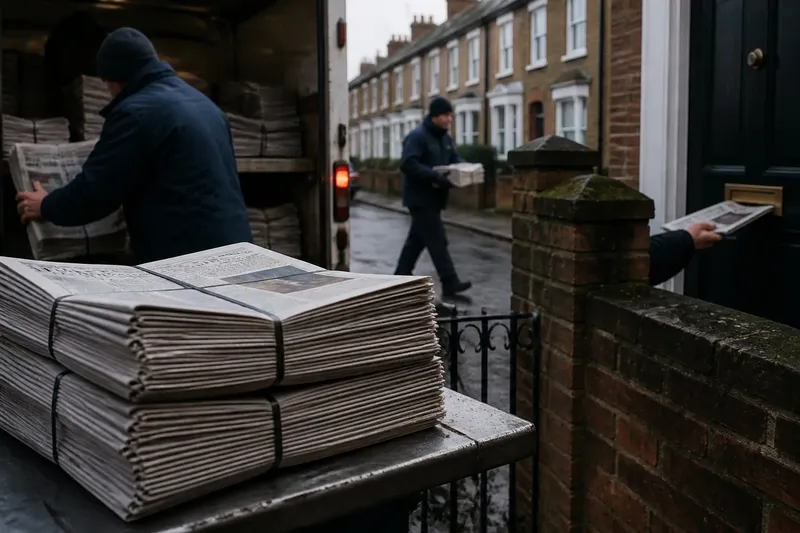
After printing, copies were counted and grouped by destination. A distributor might separate bundles for newsagents, delivery rounds and collection points, using labels or other route information to identify where each group belonged. The purpose was practical: a copy had to travel with the right batch if it was to reach the right shop or household.
Bundles moved through a network that could include a newspaper’s own distribution staff, wholesale distributors, transport firms and local retailers. The route depended on geography. A nearby shop might receive its papers by an early vehicle run, while copies for a distant area needed to leave the plant sooner to allow for a longer journey.
Handling also affected the reader’s encounter. Papers could be folded for a letterbox, stacked at a shop counter or placed in a collection point. These arrangements influenced whether someone found the paper waiting at home, picked it up on the way to work or read it later in a shared setting.
Delivery and the reader’s day
For a home-delivery reader, the paper’s arrival was the final leg of a chain that had begun well before the door opened. A carrier followed a local round, placing copies at homes or in agreed delivery spots. The round’s order and travel conditions shaped the approximate moment each household received its issue.
For a shop reader, availability depended on the delivery run and the retailer’s opening routine. A paper on a rack offered a different kind of access from one left at a doorstep: the buyer could compare titles before choosing, while a subscriber encountered the chosen paper as part of an established household routine.
Neither route gave every reader the same encounter time. Distance, the order of stops, transport delays and the work of sorting could all shift when a copy appeared. The edition might be the same, but its arrival was local and personal.
Where delays mattered
Physical distribution imposed a clear boundary: news had to be ready early enough to be printed, bundled and transported. If a major event unfolded after copies had left the press, readers might not see it in that issue. A later edition could carry the update if the newspaper had time and facilities to produce and distribute one.
That boundary also shaped the language of the paper. Editors might distinguish confirmed details from developing information, or avoid presenting a fresh but uncertain account as settled fact. A printed issue could not be silently refreshed after delivery; corrections and further developments belonged in a later edition or a subsequent issue.
Not every delay deserves close attention from a reader. Reconstructing the precise minute each copy left each stop rarely changes how the news should be understood. The more useful question is whether a story was likely to have been prepared before or after the relevant development, and whether the paper signals that its account may be incomplete.
Questions about delivery?
Why could two readers get different editions?
Some newspapers prepared more than one edition for different areas or delivery schedules. A reader served by a later print run could receive pages updated after an earlier batch had already left.
Why did a paper contain older stories?
Pages closed at different times, and not every item could be replaced when new information arrived. Some background or scheduled material also remained useful, even when a newer development had appeared elsewhere in the issue.
Did delivery time change what readers saw?
It changed when a reader encountered the paper, not necessarily the contents of that copy. A delay could make the issue feel less current, while the printed account itself remained fixed until another edition or issue appeared.
What can a reader infer from a printed issue?
The edition gives a snapshot of what that newspaper had prepared for its particular production and delivery window. Its publication date alone does not reveal when each page closed or when a specific copy reached a reader.
Reading the route today
Newspaper distribution is useful context when a printed account seems to stop just before a later development. The route explains why: newsroom decisions had to fit the press schedule, and the press schedule had to leave time for delivery. A paper was current within a window, not continuously current.
That history can sharpen a simple reading habit. Notice the edition or issue information, look for wording that marks a story as developing, and consider whether the event may have occurred after production. Those clues do not supply missing facts, but they help explain the boundary around the account.
The route to the door also gave the news a physical sequence: one issue, assembled and carried, met a reader at a particular point in the day. Newspaper distribution did not merely transport pages. It set the moment at which a fixed version of events entered someone’s routine, and that timing remains part of how print news should be read.